
 technics

I wrote down some of my experiences here, which I made during photographing, particularly in the landscape park. Maybe it's useful for some people.
Es ist erstaunlich, was eine Kamera mit wenig Licht noch anzufangen weiß. Bei meinen Aufnahmen im Landschaftspark musste meine Kamera stellenweise mit sehr wenig Licht auskommen.
I do photograph with a QV3000 digital camera of Casio. The following experiences and tips base on this camera, some might be portable to other cameras, in particular to digital cameras.

 Tripod
Blende und Verschlusszeit bei der QV3000
The hot pixel topic
Flash
Autofocus
Display
Delay timer
Be creative
Software
Some experiences

A basic condition for the taking pictures at night is a tripod.
With exposure times from partly 30 seconds and more is it logical-proves not possible to photograph from the hand.
Meine ersten Erfahrungen im Landschaftspark ohne Stativ war die, dass die meiste Kreativität dafür draufging, eine geeignete Stelle zu finden, worauf man die Kamera abstellen kann, um zu fotografieren.
The first pictures became corresponding.
contents

A second basic condition, that applies for the QV3000 only, is the following one: It's completely incomprehensible, that some fundamental functions are not contained in the QV 3000 camera.
Es ist nicht möglich, eine Verschlusszeit von über zwei Sekunden einzustellen. Außerdem kann man im S-Modus, in welchem man die Verschlusszeit selbst wählen kann, die Blende nicht einstellen.
(Im A-Modus, in welchem man die Blende frei auswählen kann, ist es nicht möglich, die Verschlusszeit einzustellen).
These functions are prevented by the software in the camera and can be called only by undocumented combinations of keys. Why? Casio will know it...
Hot-pixelEine Idee wäre, dass Casio die Verschlusszeit deshalb auf 2 Sekunden begrenzt hat, um Reklamationen aufgrund von sogenannten Hot-pixel zu vermeiden.
Um die Verschlusszeit auf mehr als zwei Sekunden einzustellen, muss die Kamera in den S-Modus geschaltet werden. Dann über die Pfeil-nach-unten-Taste eine Belichtungszeit von 2 Sekunden auswählen.
Jetzt die 'Set-Taste' und dann gleichzeitig die Pfeil-nach-unten-Taste drücken. Nun ist eine Verschlusszeit von 2,5 Sekunden eingestellt. Es lassen sich jetzt Verschlusszeiten bis 60 Sekunden wählen.
Die 'höchste' Verschlusszeit ist 'bulb'. Ist diese Verschlusszeit eingestellt, so öffnet der Verschluss solange man den Auslöseknopf drückt.
Diese Funktion ist daher nicht besonders sinnvoll, da man an die QV3000 keine externen Auslöser anschließen kann.
Um jetzt auch noch die Blende frei einstellen zu können, muss wieder eine Tastenkombination gedrückt werden.
Durch Drücken der Set-Taste zusammen mit der Pfeil-nach-links- oder der Pfeil-nach-rechts-Taste lässt sich auch die Blende wählen. Wurde die Kamera ausgeschaltet, muss diese Prozedur eventuell wiederholt werden.
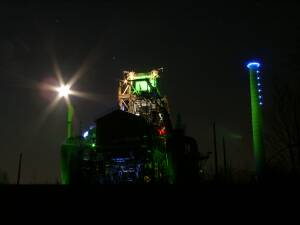
Aperture F8, 40 seconds exposure time

In the internet-newsgroup
de.alt.rec.digitalfotografie
the topic Hot pixel was passionately discussed. But what actually are ' hot pixels '?
Technisch bedingt lässt sich ein CCD, also der Chip in einer Digitalkamera, welche dafür sorgt, dass das zu fotografierende Bild in ein digitales Bild umgewandelt wird, nicht fehlerfrei hergestellen
(anyhow not to justifiable costs).
Das heißt, dass einige Pixel auf dem CCD weiße, rote, blaue Punkte auf dem Foto erzeugen können.
Die Wahrscheinlichkeit, dass solche fehlerhaften Pixel auftreten, erhöht sich mit der Belichtungszeit und der Temparatur des CCD.
In the summer we will observe thus more hot pixels as in the winter, on the day fewer than at the night, since we have to increase the expose time due to few light. Even with long exposures in the dark, these hot pixels disturb very much.
A very detailed essay about the hot pixel problem can be found on this page:
hot pixels
(in english).
Two Tools for the fight against Hot pixel can be found at
www.mediachange.com:
1.) HotPixels Eliminator
2.) BlackFrame NR
which I did not try until now, a report on it will follow.
contents

The flash disturbs in the most cases, it should be switched off. But sometimes it is quite useful in addition, in the darkness, if you like to arrange the foreground brighter.
|
|
|
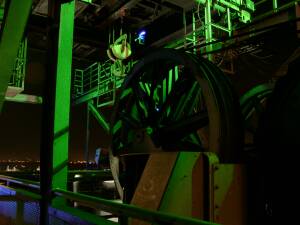
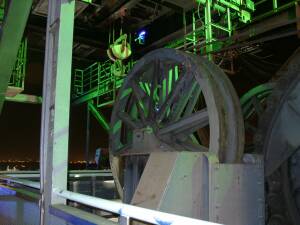

Because the autofocus does not work in the darkness, the focus should be set to infinite. This mostly does it.
The disadvantage of the QV3000 is that you can focus only with the display. This unfortunately does not have the necessary resolution, in order to be able to detect the sharpness.
contents

Because the autofocus does not work in the darkness, the focus should be set to infinite. This mostly does it.
Reasonable aligning of the camera to the motive to be taken up is hardly possible with a switched on display. Therefore it should be switched off, when you look through the viewfinder.
contents

Vielleicht nicht unbedingt nötig, aber ich habe mir angewöhnt, den Selbstauslöser auf zwei Sekunden zu stellen. Damit ist gewährleistet, dass das Bild auch beim Auslösen nicht verwackelt.
contents

Der wahnsinnige Vorteil beim digitalen Fotografieren ist der, dass man das Ergebnis sofort auf dem Display sehen kann.
Ist ein Bild über- oder unterbelichtet, so kann man das sofort auf dem Display sehen, und wiederholt die Aufnahme mit einer anderen Blende oder Verschlusszeit.
Extreme effects as on my pictures can be implemented very easily, since you can experiment.
Ich glaube, mit Blende und Verschlusszeit muss jeder selbst spielen. Es hat sich allerdings bewährt, ein Motiv nicht nur einmal zu fotografieren, sondern mit verschiedenen Blende/Verschlusszeitkombinationen.
At home at your PC you can select the best photos and delete the remainder. Admittedly those people are in the advantage, who own a 340MB-Microdrive of IBM.
I never did create more than 130 pictures in a photo session ever. You can store almost twice as many pictures on the Microdrive.
|
|
|
|
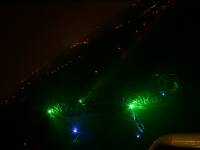
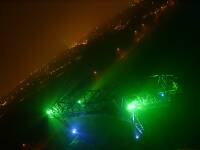
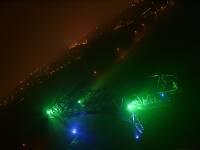

With each photo the QV3000 stores some data, which permits subsequently to get a quantity of information about a picture.
Man kann z.B. nachvollziehen, mit welcher Blende und Verschlusszeit ein Foto aufgenommen wurde, ob der Blitz verwendet wurde, wann das Foto erstellt und welcher Zoom verwendet wurde, uvm.
To be able to read out these information, you need a program called ' DicaInfo ', what can be downloaded
here
. Additionally there is a tool by DicaSoft, which can remote controls the QV3000 over the serial interface
( remote control),
for what ever.
contents

Bei einer F8-Blende und einer dementsprechend längeren Verschlusszeit bekommt man bei punktuellen Lichtquellen einen Strahleneffekt auf das Foto.
The moon is shining
Bei Sternen am Himmel ist zu beachten, dass sich die Erde dreht !!! Bei Verschlusszeiten von mehr als 20 bis 30 Sekunden bekommt man statt Sterne Streifen auf das Bild.
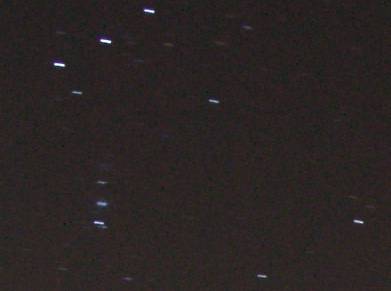
Stripes, caused by the earth rotation
Obwohl es fast absolut dunkel ist, kann man dennoch Abenddämmerungsfotos hinbekommen. F2-Blende mit einer langen Verschlusszeit wirken Wunder.
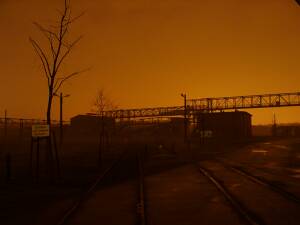
Aperture F2, 10 seconds exposure time